

Strengthening Strategy and Learning for Collective Impact in the Fight for Democracy
Guest Post: A Discussion Paper on Strategy, Impact, and Learning for Democracy Organizations

Brendan Halloran is an independent consultant specializing in strategy, impact, and learning for democracy and governance organizations. Suvarna Hulawale is Senior Director of Strategy and Learning at FairVote. This discussion paper arises from their shared work at the intersection of organizational strategy and democratic reform. The arguments and recommendations here are the authors’ own.
The Challenge
Democracy in the United States is under significant threat. The country is currently experiencing a democratic crisis on multiple fronts, yet many of the underlying causes are structural and systemic. There are upcoming critical junctures, for example around electoral integrity and legitimacy, but the effort to safeguard and ultimately to strengthen democracy will be a long-term process. Efforts to address both the immediate manifestations and the longer-term contributing factors will need to be strategic and adaptive to have a meaningful and sustainable impact on the country’s democratic trajectory.
The many and diverse civic organizations in the US dedicated to safeguarding and strengthening democracy are working to meet this crisis. This ecosystem of organizations works on numerous issues and approaches of relevance to the short- and long-term prospects for democracy in the country. However, many organizations are facing challenging questions about whether and how their strategies and tools are contributing most meaningfully in this critical and complex moment of democratic crisis.
Given the unprecedented speed and the many dimensions across which democracy is unraveling, as well as the systemic nature of the causes, pro-democracy actors need to be able to revise and adapt their strategies and approaches based on an evolving context, rigorous assessment, and collective learning. We believe there is an opportunity and a need to strengthen strategy, impact and learning for organizations, coalitions and ecosystems in the democracy space. This will enable them to more effectively understand, navigate and shift the systemic causes and consequences of democratic decline and crisis.
Fortunately, we don’t have to reinvent the wheel. The pro-democracy community in the US can draw on existing and emerging resources, examples and practical lessons. In what follows, we will outline questions and challenges for existing practices of strategy, impact and learning for democracy, while pointing to useful examples and resources that could be integrated going forward. We encourage democracy-focused organizations – individually and collectively – to explore how to integrate these approaches in their organizational systems, practices and cultures.
Strategy
Democracy in the US has been on the decline for more than a decade, paralleling similar trends in other parts of the globe. A longer view recognizes democratic limitations dating back to the country’s founding, as well as significant efforts to address them over time. Over the past decades, thought leaders, academics, and other reformers in this space have put forth many innovative ideas about ways to fix elements of our system that are obviously broken. Other organizations are more action-oriented, mobilizing resistance, documenting corruption, innovating at the local level, or undertaking civic education, among other efforts. In some cases, there is more emphasis on ‘what’ needs to change, with less clarity on ‘how’ to achieve these shifts. In other cases, organizations are working out the ‘how’ in practice, but without a broader sense of ‘what’ these more isolated efforts need to add up to in order to achieve more meaningful and sustainable change.
In general, although democracy organizations have strategies and plans, many would benefit from stronger and more explicit Theories of Change (ToC). ToCs encourage actors to clarify the outcome they are working towards, the obstacles and barriers to change, and what it will take to make meaningful and sustainable progress. In other words, they bring together the ‘what’ and ‘how’ of change, based on rigorous thinking, available evidence, and diverse experiences and perspectives of those working on these efforts. This is particularly true given the complex system that underpins democratic governance in this country.
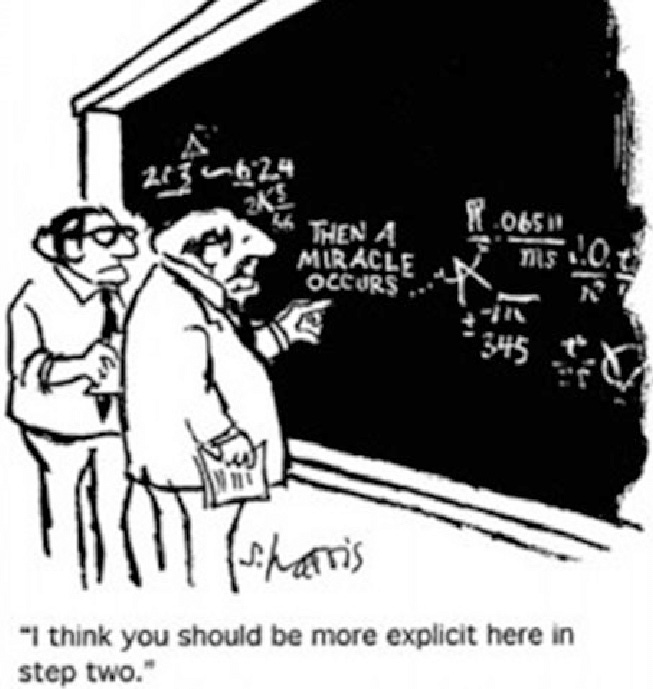
A ToC should articulate our best understanding of what it takes to achieve the change or goal we are working towards. A good ToC is not a blueprint for change, but it does force us to articulate our thinking, including our uncertainties and assumptions. Too often, ToCs, strategies and actions are underpinned by widely shared but unstated assumptions that would benefit from being further clarified, discussed, tested and strengthened.
Source: frompoverty.oxfam.org.uk/
For example, many organizations produce evidence, data, analysis, recommendations and other information which they seek to put into the hands of relevant stakeholders, whether they be lawmakers, government oversight actors, or the broader public. However, the people generating this information often make assumptions about whether and how these actors will be motivated and/or capable of acting on this information, and whether any actions they would take as a result would be effective or sustainable. This is particularly true as Americans are increasingly inundated with information, including misinformation, that leaves many unsure of whether or how to act.
In other cases, those most capable and motivated to act on information are unable – on their own – to achieve the change needed. Particularly when our strategies depend on others taking key actions, we need more robust and explicit analytical tools to assess actors’ motivations, capabilities, opportunities and constraints.
The US context for democracy safeguarding and strengthening efforts is shifting in significant and ongoing ways, meaning our strategic thinking and approaches need to evolve as well. Crucially, some historically relevant enabling conditions, leverage points and tactics for democracy strengthening may not be viable in the current context of hyper-partisanship, pervasive misinformation, dark money, and growing executive overreach. Given the deep public divides about the nature and severity of threats to democracy, even seemingly common-sense actions or reforms face significant challenges.
Ultimately, democracy-focused organizations are seeking to understand, navigate and shift a complex system of democratic governance. Effective strategies acknowledge this complex system and suggest viable directions and pathways within it based on clear, robust and adaptable thinking. This strategic thinking should reflect a systems-based ToC. This would unpack why and how the current system produces its outcomes, how reform and other interventions interact with and shift these evolving dynamics, and why those shifts are expected to move the system toward the democratic outcomes reformers seek.
Furthermore, while individual organizations or efforts may play a key role, we need to be much more intentional about shared strategic thinking and ToCs that inform more coordinated and complementary action if we are to have any hope of shifting a system shaped by powerful structural factors and trends.
Strategy resources and tools:
A practical guide to “everyday political analysis” that helps democracy reformers reflect on key actors, their interests, and what influences them. This is ongoing, iterative and participatory work as teams and coalitions navigate dynamic political contexts towards long term change.
A practical ToC workbook that takes an organization through five steps to develop a Theory of Change from power analysis to leverage points to necessary and sufficient interventions to advance towards the desired objectives. It encourages a participatory process to ensure shared understanding and ownership, while making assumptions explicit and testable as the strategy is implemented and evolves.
Impact
Democracy-focused organizations have distinct but broadly complementary objectives for safeguarding, strengthening and renewing our system of democracy. These include efforts to block authoritarian actions, bridge social and political divides, strengthen the civic infrastructure for social belonging, and build elements of the democracy we need. Impact within each of these domains will look very different. Furthermore, it’s difficult for organizations to know if their contribution is moving the needle towards meaningful and sustainable impact, or amounts to adding drops to a very leaky bucket.
Democracy organizations and the broader ecosystem would benefit from a more systematic approach to defining, tracking and assessing the diverse impacts they are working towards. Some democracy activists may reject the idea that they can or should pre-define their impacts, arguing (not without some merit) that safeguarding and strengthening democracy is more art than science. Of course, even strong ToCs do not provide a clear blueprint for impact, and there is a strong need for ongoing adaptation given the complex context. This does not take away from the need to clarify and strengthen our thinking about what impact we are seeking to achieve and how we will know if we are moving in the right direction, or need to pivot. This includes both longer-term shifts and more immediate incremental milestones. It also entails both direct changes towards objectives – like approval and implementation of a policy – and less direct efforts to strengthen the enabling environment for change – such as building and sustaining a broad coalition.
In some cases, the language of impact used by democracy organizations – both externally and internally – to describe the change they are working towards is unhelpfully vague. Terms like ‘fighting back’, ‘winning’ or ‘holding to account’ seem to make intuitive sense, but may obscure more than they clarify.
In other cases, organizations’ metrics or indicators are narrowly confined to that which can be relatively easily counted. This might include a number of articles, reports, events, or other activities. In other cases, these indicators might include number of people reached with a campaign, information, or other engagement, and the discreet action they take as a response, such as a social media interaction, signing a petition, making a donation, or showing up for an event or protest. These measures do help understand the outreach and public support, but do they constitute ‘impact’?
Furthermore, simple indicators frequently become quantitative targets. This can incentivize organizations to ‘do more’ of a given activity, rather than assess whether and how it’s contributing to their goals. Without a clear ToC, organizations may lack clarity about how the incremental changes they are seeing connect to a viable pathway to the impact they are pursuing.
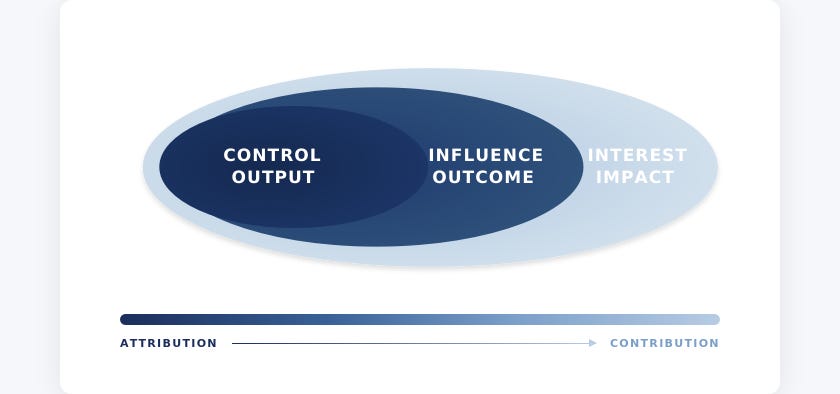
Fundamentally, it’s easiest to measure the outputs under organizations more direct control. Assessing the influence of these actions – their outcomes – can be more challenging and requires both the right tools and adequate resources to undertake them. It’s generally hard, but not impossible, to understand whether outputs and outcomes add up to impact on the ultimate changes we are interested in.
Differentiating outputs, outcomes and impacts – and assessing each appropriately – helps organizations better understand their strategic contribution to longer-term changes. It’s also a useful exercise for multiple organizations working towards a shared goal to consider whether and how their collective efforts are adding up to more significant outcomes and impacts.
Source: Slunge, Daniel & Drakenberg, Olof & Ekbom, Anders & Göthberg, Maria & Knaggård, Åsa & Sahlin, Ullrika. 2019. Stakeholder Interaction in Research Processes - A Guide for Researchers and Research Groups.
So how should organizations measure and assess their efforts and the contribution of their actions to broader impacts? There is no single answer, but ‘evaluative thinking’ – the practice of asking questions about contribution and impact – and seeking out diverse evidence and perspectives to help answer these – is essential for organizations navigating complex systems. Furthermore, there are increasingly diverse and robust evaluative tools at our disposal that can provide evidence-based insights (if not perfect answers) to inform strategic decision making.

That said, meaningful and sustainable change in the system of democratic governance is complex – even more so in the current context of unprecedented backsliding. Systems change frameworks, such as the ‘iceberg model’, suggest that significant change is often ‘below the water line’, i.e., less visible elements of the system like relationships, power, and mental models. However, many organizations focus on more visible and tangible aspects of the system – formal institutions, rules and processes.
Other systems change approaches focus on interactions among elements rather than the linear change models that predominate in many organizations. Ultimately, there is no single silver bullet for meaningful impact in a complex system, rather diverse and incremental shifts across multiple leverage points.
Individual organizations and the broader ecosystem would benefit from clearer articulation of diverse intermediate shifts that help us understand whether and how the system is changing in response to our interventions and engagements. In particular, this includes both more and less visible change, as well as more direct progress and more indirect change in the enabling conditions.
For example, what are the elements needed for a meaningful reform to advance at a given level (local, state or nationally)? We need to define and assess the coherence, strength and sustainability of a core coalition, broader public support, and incentives of other key stakeholders. We need to identify and track other enabling or constraining factors that need to be considered. Furthermore, we need to articulate and assess milestones along a viable change pathway for these intermediate changes to add up to the ultimate goal we are seeking to achieve. Clear ToCs underpinned by robust analysis can provide a framework for defining change and ultimately impact that an organizational monitoring and evaluation approach can be built on.
Finally, we know that progress, and certainly impact, for democratic safeguarding and strengthening, can only be the result of a coherent and collaborative effort. Thus, we need to engage collectively to define, track and assess those impacts, as well as to integrate those insights into our ongoing sensemaking and strategic decision making.
Impact resources and tools:
A short overview of “evaluative thinking” that helps us be more confident in our decision making in contexts of change and uncertainty. Evaluative thinking emphasizes asking questions with genuine curiosity and openness, bringing together and analyzing diverse data and evidence (as well as our own experiences), and collective reflection to benefit from diverse points of view.
A guide for measuring systems change. The guide outlines several methodologies, common systems change approaches, and concrete examples in practice drawn.
A guide to how to think about and undertake evaluation of systems change. The guide outlines the challenges, evolution and elements of evaluation that supports strategy, learning and adaptation for systems change efforts.
Learning
Given the unprecedented nature of the current democratic backsliding in the US and the inherent complexity in safeguarding and strengthening democracy in this context, organizations need to be constantly learning and adapting. Most individuals and teams are learning all the time and applying that learning to make adjustments and improvements where they can. However, many organizations do not have the intentional and collective learning priorities, practices, or enabling conditions to incentivize and facilitate the most meaningful learning and adaptation that the current context demands.
For example:
Does organizational leadership explicitly and consistently prioritize and model learning, including acknowledging what they aren’t sure of or what hasn’t worked?
Is there an organizational culture of asking questions, including hard questions? Does the organization have a learning agenda that articulates priority questions and themes?
Does the organization regularly engage with diverse evidence, including that which doesn’t align with prior assumptions?
Are lessons agreed on, documented and integrated into decisions and practices, including those that imply significant adaptations to strategy or ways of working?
Does the organization have spaces for learning with peer organizations? Does it facilitate participatory learning with grassroots and front-line individuals and groups?
Do the organization’s donors encourage the organization to acknowledge questions about strategies and impacts and how the organization will learn about these?
Do donors facilitate collective learning with other grantees working on similar issues, and does this collective learning influence funding strategies?
Relatively few organizations would be able to answer all of these with a definitive yes, suggesting that they don’t have a fully supportive enabling environment for learning. In the context of many organizations struggling with funding, learning is often a ‘nice to have’ rather than a ‘need to have’. Democracy-promoting organizations don’t have the time or resources to endlessly question underlying principles or have a strategic learning retreat every month. But learning is not a luxury. It’s fundamental to understanding, navigating and ultimately shifting the diverse the democratic governance system to safeguard and strengthen.
Furthermore, in contexts of complexity, different kinds of learning are needed. Learning sits at three levels:
Learning focused on action and implementation – “Did we do things right?”
Learning focused on strategy and outcomes – “Did we do the right things?”
Learning focused on underlying principles and ToC – “How do we know what the right things are in this context?”
As these learning levels and questions suggestion, learning is not separate from strategy and impact, rather it ties them together and connects to action.
Finally, learning-focused organizations can be much more effective at adapting in complex contexts. However, given the collective challenge of safeguarding and strengthening democracy, there is a significant need for shared learning across organizations. That said, the incentives, resources and spaces for joint learning are even less common than in individual organizations. Some organizations working on similar issues or in a similar space may be concerned about sharing their insights, evidence, questions, doubts, or (especially) failures with peer organizations, particularly those competing for the same pool of donor funds. Thus, funders have a particular opportunity and obligation to create a safe space and positive incentives (not to mention resources) for collective learning.
Learning resources and tools:
The Open Contracting Partnership works to ensure the public procurement is more transparent, accountable and effective by working with governments and civic actors around the world to improve standards, systems and practices. The organization has a strong focus on learning both internally and with its partners. This includes, among other practices, regular review and reflection sessions for organizational strategy and collaborative projects with external stakeholders. Example of an earlier organizational learning plan.
Strategy Testing is a practical approach to learning and adaptation. It focuses on clarifying strategy, then setting up practices to assess and reflect on progress, challenges and changes in the context - leading to ongoing strategic adaptation.
Conclusion
The United States is facing its most serious democratic crisis in generations, the result of complex root causes as well as the ongoing actions of key individuals in power. While there has been an upsurge of innovative and robust ideas and solutions for addressing both this current episode of backsliding and many of the structural causes, the pathways to achieving these changes are far from straightforward. Similarly, there is an unprecedented effort being undertaken to organize and mobilize citizens to defend democracy from the growing threat of authoritarianism. However, although the experiences of other countries who have faced similar situations are instructive, there is no clear blueprint for defending democracy. Thus, organizations working to safeguard and strengthen democracy are navigating significant complexity, uncertainty and challenges.
In many ways, individuals and organizations across the ecosystem were made for this moment of democratic crisis and – potentially – renewal. However, effectively understanding, navigating and shifting the system of democratic governance will require stronger strategy, impact and learning systems, practices, capacities and organizational cultures.
Some might question whether this is the right moment for investing resources in these areas or suggest that the necessary learning is happening. However, we believe that now is the right time to strengthen strategy, impact and learning for both the short and long-term effort to preserve and strengthen our democracy. The ecosystem has never needed these capacities and tools more than now, and weaknesses in strategic focus, assessment of progress and impact, and learning for adaptation could have significant consequences.
This need not be a solo effort by individual organizations. Where multiple organizations are working on a similar set of issues, tactics or geography, this could be an opportunity for coordinated or shared strategy, impact and learning practices. Methodologies like Collective Impact encourage shared strategic direction, coordinated and complementary actions, and joint monitoring, assessment and learning, often supported by an anchoring or coordinating organization. Organizations pooling resources and undertaking collective strategy, impact and learning processes could not only be more efficient, but also unlock deeper synergies among organizations leading to more meaningful change. In other words, strategy, impact and learning efforts might help bridge the silos across the ecosystem.
Finally, funders of democracy organizations have a strong influence on the enabling environment for organizations to strengthen strategy, impact and learning. Funder practices and priorities shape the resources, incentives and opportunities for organizations to invest and prioritize strategy, impact and learning. For example, if funders accept and reward relatively simple output metrics that don’t clearly relate to progress towards meaningful outcomes (perhaps because a Theory of Change is vague or absent), then organizations will have less incentive (and likely resources) to invest in thinking through, tracking and assessing these higher level changes. Much of this relates to funders’ own strategy, impact and learning systems and practices, which also likely would benefit from further investment and strengthening.
Ideally, democracy funders and organizations would jointly invest in incentivizing and strengthening shared strategy, impact and learning infrastructure and practices. This would enable actors across the ecosystem to collaboratively learn and adapt on the basis of collective reflection, pooled data, joint assessment and increasingly sharp and aligned strategic focus. Concretely, this could include:
Collaborative strategy sessions around major strategic democracy challenges and opportunities (e.g., election integrity, local democratic innovation, structural reforms)
Co-creating strategic learning questions and holding regular spaces to reflect on these
Jointly commissioning evaluations of cases of successful campaigns or other areas of progress, efforts that didn’t produce intended results, and/or other moments or issues with broader learning potential
Given the nature of the challenges we face, we believe that the democracy ecosystem needs to prioritize and strengthen strategy, impact and learning if it is to play a significant role in helping the country traverse the current crisis to a more democratic future.