


The New Ideas Corner is an open invitation for readers, practitioners, scholars, organizers, and democracy-builders to share pro-democracy ideas, especially early-stage or underexplored ones. This is a place for constructive experimentation. These ideas aim to strengthen representation, participation, accountability, trust, or democratic governance more broadly. The views expressed here are the author’s own.
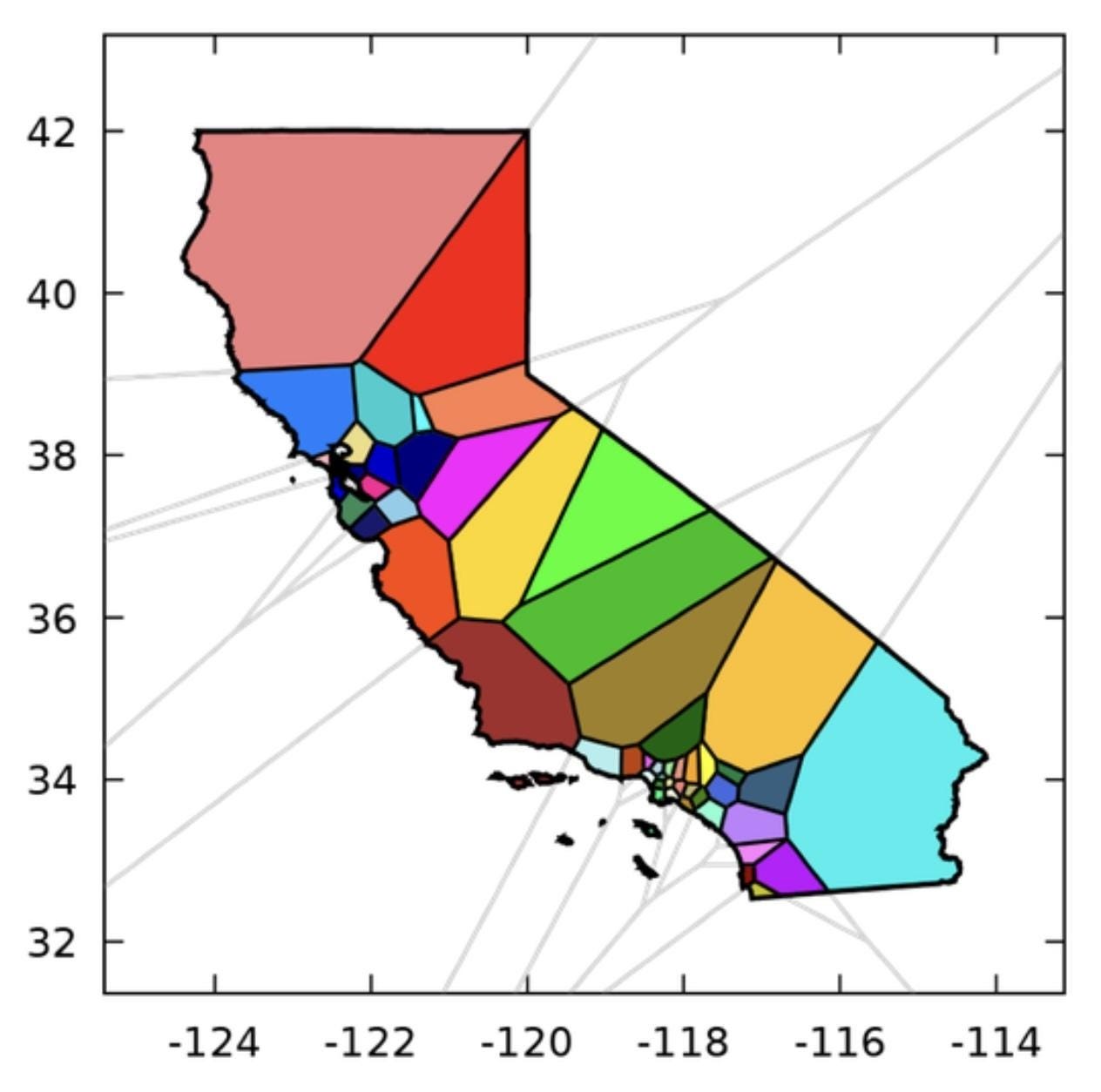
California redistricted using the method recommended below
Our democracy is going to Hell in a handbasket, as a lively old expression has it. I think the point of the “handbasket” is that it is a fast, efficient, no-nonsense conveyance, and in this case, gerrymanders across the nation are the handbasket. From Texas to California to Virginia to Florida, and plenty of points in between, our two parties are racing to disenfranchise each other’s voters. Citizens redistricting commissions—reformers’ favored bulwark against gerrymanders—have been revealed as delicate and inadequate by their quick demise. When California suspended its citizens commission and resurrected partisan gerrymandering, Common Cause reluctantly went along, reversing itself on decades of advocating such commissions. This race for partisan advantage will leave many Americans unrepresented and powerless; but not entering this race to the down below would, Common Cause reasons, “amount to a call for unilateral political disarmament in the face of authoritarian efforts to undermine fair representation and people-powered democracy.” Tough choice.
There is a path out of this dilemma, though, a path America can take before the 2030 census. It is a straight and narrow path, as paths from damnation often are. The narrow part is now widely acknowledged: redistricting must be national, the same in all states. The straight part, however, requires a new strategy. The straight path to a nation-wide end to gerrymandering, our best path to a healthy democracy, does not wind through citizens commissions at all. It requires, instead, what reformers’ close allies, the mathematicians, have long been developing: a strict rule for the creation of districts, a rule that eliminates discretion entirely. It is time to let our allies speak up.
An honest look at the weaknesses of citizens redistricting commissions makes clear that they are not a practical mechanism to produce fair districts. (I summarize here the case against them I made in an open letter to Common Cause titled “Damned If You Do, Damned If You Don’t.”) Fortunately, there is a mathematical redistricting solution ready that is better in every way, which we’ll get to later. Unfortunately, the electoral reform community—including FairVote and many other organizations along with Common Cause—still supports citizens commissions, specifically in the Redistricting Reform Act of 2025. (In “How Reform Fails,” I address the larger reform project and the community’s resistance to making a new plan.)
A high-stakes game
Citizens commissions sound good in theory but have a damning practical problem. It’s the problem of “capture,” i.e. the potential for outsiders to take control of their decision-making. The discretion that citizens commissions have over redistricting makes them prime targets for capture. As Karl Rove put it at the start of these gerrymander wars, “He who controls redistricting can control Congress.” When big data and computing power can almost guarantee successful gerrymanders and electoral victories, the incentives to do whatever it takes to control redistricting are astronomical.
Recognizing the stakes, the most powerful institutions in American society are engaged in the redistricting battle. Citizens commissions have no business in a fight of this firepower (and legislatures across the country are brushing them aside). They belong to a lower level of institution, like library boards, public utility commissions, or boards of education. Even at that level, we have seen in recent decades campaigns of harassment, bullying, propaganda, spurious lawsuits, and other tactics aimed at capture. Such institutions do sometimes have real money and other values at stake, but nothing like redistricting has. It is naive to imagine that commissions will somehow be immune to capture when they are in charge of something orders-of-magnitude more valuable. (And now we’re in an era of death threats and extraordinary coercion against even more powerful institutions such as big law firms, universities, and federal judges.) Giving commissions discretionary power over redistricting is like asking them to carry around a suitcase full of diamonds.
Incentives to capture are bolstered by opportunity. Commissioners are selected through complex, often opaque processes that vary among states. Each one of multiple steps meant to protect the neutrality of the process is also an opportunity for interference by unscrupulous actors. In sum, discretionary power over district boundaries makes these commissions worth attempting to con, capture, or coerce, and the complexity of the selection process makes those attempts likelier to succeed. Now multiply our problem by fifty, since the currently proposed national solution involves at least fifty commissions, one per state. The result is unlikely to be the technocratic dream of noble and disinterested public servants dedicated to creating fair districts.
If by some miracle, most of the fifty commissions maintain the highest integrity, they will still be filled with diverse values, personalities, and ideas about their goals. All of these differences can skew in partisan directions. Consequently, commissions—even if uncorrupted—can easily vary so much or so systematically as to undermine the one requirement the gerrymander wars have forced everyone to acknowledge: a national system that is the same in all states.
As a national plan to solve the problem of partisan gerrymandering, citizens commissions are unworkable. Discretion and complexity are the enemies of any real solution. A real solution to gerrymandering will install a clear rule—the same in every state—that people can see being implemented. It will explicitly define exactly how to draw electoral districts. The barrier to this plan is that, historically, we have preserved discretion in redistricting for the sake other social goals besides fair and neutral districts. The key to moving democracy reform forward is choosing to simplify redistricting’s goals.
Restraining politics
Creating ideal electoral districts is a project that mathematicians have been rapidly developing for decades. They now have algorithms to redistrict by an explicit rule and give the whole country compact districts that eliminate discretion and complexity entirely. This solution to gerrymandering is better than commissions in every way. It eliminates the power to gerrymander, so there is nothing to capture. It is also more consistent, nationally implementable, easier to monitor, fairer, simpler, much cheaper, and impossible to game. (It is what an economist might call “Pareto superior” to commissions.) How exactly a solid method was discovered has an element of almost comical serendipity that we’ll get to, a by-product of legal battles over gerrymanders.
Redistricting by a fixed rule is a path completely different from the one that brought us to our current crisis. Gerrymandering grew to become the pernicious problem it is partly because we accepted using redistricting for diverse and complex social goals that we considered benevolent. The Voting Rights Act of 1965, in particular, achieved greater minority representation in Congress through designing majority-minority districts. It turned out, however, that once the process was up for grabs, it became very difficult to justify blocking other people’s goals we don’t consider benevolent—such as partisan power grabs—leading to today’s race to the bottom.
The solution is to cut a deal with the gerrymanderers to jointly give up discretion: we’ll give up the power to gerrymander for our good and noble reasons, if you’ll give up the power to gerrymander for your dastardly and nefarious reasons. It is the logic of gun control: we are all better off if we all give up a dangerous power. And the Supreme Court is widely expected to limit or strike down section 2 of the Voting Rights Act by this summer, anyway, in its decision in Louisiana v. Callais, so majority-minority districts will likely be gerrymandered away. Furthermore, there is no longer the consensus there was in the 1960s that manipulating the rules to help minorities is moral and effective. Absent that 1960s consensus, a more transactional deal-cutting may be the best way to serve minority rights, as well as democracy.
Other benevolent social goals are also better addressed by other methods besides discretionary redistricting. Once “communities of interest” cannot be deliberately broken up by gerrymandering, they will naturally be grouped together in the compact districts a rule creates. And ranked choice voting will make many more districts competitive. These social goals do not need the heavy hand of discretionary redistricting.
The lesson of the gerrymander wars is that redistricting in different ways in different states damages democracy. Once we recognize that fairness and national consistency require constraints on how states redistrict, the logical endpoint is to fully constrain them with a single strict rule. Recognize this as a good thing. Recognize simplicity and verifiability (the opposites of complexity and discretion) as democratic values. Then dispense with the middlemen: legislative committees and citizens commissions.
An over-performing helpmate
One role of math in redistricting developed in an extremely fortuitous way. Reformers recruited mathematicians to define precise degrees of gerrymandering, hoping to satisfy the Supreme Court that an objective measure, rather than political judgments, could identify corrupt maps (a project doomed by the Supreme Court’s swing to supporting partisan gerrymandering). Ironically—and this is the fortuitous part—a methodology mathematicians applied to the impossibly complex problem of defining degrees of malfeasance was to first define ideally fair districts, and then to define degrees of deviation from that ideal. “First, we pin down the geometric minimum—the most compact way to bundle those dots inside the state’s jagged borders into its exact number of congressional districts, each with equal population” (Roland Fryer, “Geometry Solves Gerrymandering”). It almost makes you laugh out loud when you see it: the answer to our problem—fair electoral maps—falls into our laps as a preliminary step along the way in a doomed project! A strategy that was losing in court and has been blown up by the gerrymander wars turns out to have a serious silver lining.
Aside from equal populations (which is the purpose of redistricting), fair districts have only one essential criterion: compactness. Compactness is practically synonymous with the very idea of a “district,” or a town or village or any geographic place where people are living together. Still, compactness can be codified in various ways. The important thing, though, is that the many plausible definitions math has produced are all pretty similar in practice, and all prevent gerrymanders. “The empirical data show compactness is not cosmetic; it’s what turns a fixed match into a fair fight,” as Fryer puts it.
The shortest-splitline algorithm is “proof of concept” for redistricting by a strict rule that has a unique output applicable anywhere. It’s crude, uses only elementary-school arithmetic, and gets the job done: let N be the number of districts and A+B=N, where A and B are whole numbers near half of N (e.g., 4+3=7); choose the shortest possible dividing line that splits the state into two parts with population ratio A:B; (if more than one is shortest, choose the closest to north-south, and if equally close, the westernmost); repeat until subparts are not further divisible. The splitline method will always produce a single answer, a single correct way to create the desired number of districts, all with equal population. No discretion, no complexity, no partisanship, no lawsuits. No unfairness.
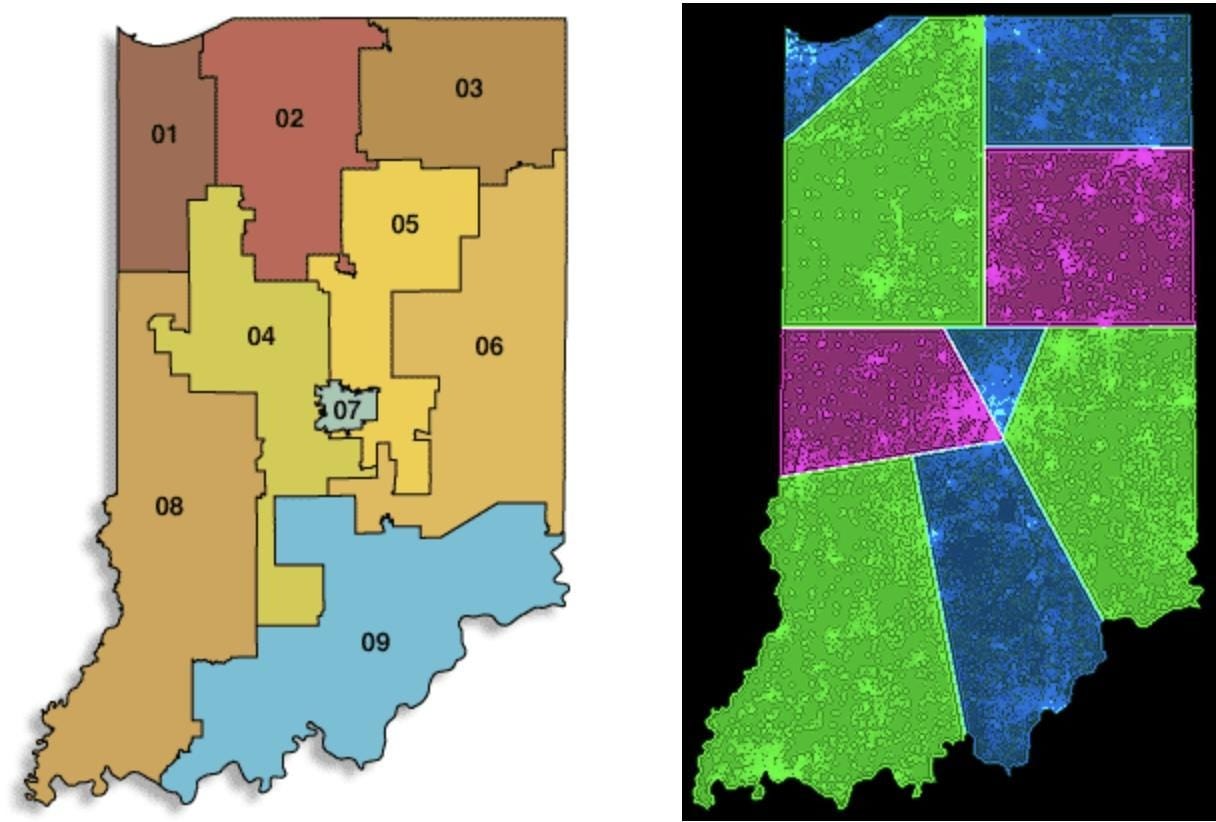
Indiana redistricted using the splitline algorithm
Math can do better than splitline’s quick and dirty, however, such as Cohen-Addad, Klein, and Young’s “Balanced Power Diagrams for Redistricting” (2018). (Here’s an accessible summary.) Their method minimizes voter distance from district centers, adapting a general strategy for efficient distribution of services (fire stations, hospitals, grocery stores, etc.) that can incorporate refinements, such as accounting for water, mountains, or local political boundaries. The mathematicians can do what the reformers really want: eliminate gerrymandering and create fair electoral districts the same way in every state by a publicly visible and consensus method.
The battle before us today calls for a new strategy to fight the evil of gerrymandering, not a return to citizens commissions. We need a clear rule on exactly how electoral district lines will be drawn, not on who gets to draw them. The time to change strategy is now—in time for the 2030 census and while the country’s attention is on redistricting. The methods are ready to hand, and the first action item is clear: revise the Redistricting Reform Act to mandate one districting rule nationwide, instead of fifty citizens commissions. We can turn misfortune to advantage. To end gerrymandering finally, we need Common Cause and FairVote and all who follow them to embrace a new and better plan.
Jerry Cayford is a philosopher and policy analyst in the Washington, DC area. “The Radical Reading of Wittgenstein” was his dissertation for a Ph.D. in philosophy from Northwestern University, and he has a bachelor’s in economics from UC Berkeley. He co‑authored Democracy in Practice: Public Participation in Environmental Decisions with Thomas C. Beierle, and “American Patent Policy, Biotechnology, and African Agriculture: The Case for Policy Change” with Michael R. Taylor. Solo works include “Breeding Sanity into the GM Food Debate.”