

Organizing Gets the Goods
Time after time, grassroots organizing has been the difference between election reform campaigns that succeed and ones that don't.

This piece is the first of a three-part series that draws on findings from Pathways to Victory: Lessons from 2024’s Electoral Reform Ballot Measures, a report by FairVote Action examining the campaigns behind ranked choice voting (RCV) and open primary ballot measures that appeared before voters in November 2024. Conducted by independent learning consultant Janice Dean and co-authored by FairVote Action’s Jeremy Rose, the study draws on 45 interviews with campaign strategists, organizers, volunteers, and election administrators across the jurisdictions that voted on RCV in November 2024, with a particular focus on lessons from Alaska, Colorado, Nevada, Oregon, and Washington, DC. The report’s methodology also leveraged quantitative analysis of election results and polling data, a review of campaign documents, historical assessments, and relevant academic research.
By Suvarna Hulawale, Eveline Dowling, and Jeremy Rose
Image Source: Medium
Introduction
On the morning of November 5, 2024, most of the politicos in Washington, DC were focused on the close of a highly anticipated presidential election. Local DC election reform advocates, on the other hand, were focused on their own backyard, making a final push to boost margins in support of Initiative 83, proposing ranked choice voting (RCV) and allowing independents to vote in partisan primaries. Initiative 83was widely expected to pass; an early internal poll had found support at 62%. What was less certain was the margin, particularly given that the DC Democratic Party had come out in opposition.
In precincts across the District, Initiative 83 campaign volunteers were ready to make the case for the measure on Election Day. The need for that direct contact was evident: some voters reported seeing campaign signage without knowing what the initiative actually proposed. Campaign participants later reflected that this was precisely the gap that retail politics was designed to close. As one volunteer noted in a post-election debrief, working at polling places yielded an estimated three to five persuadable conversations per hour; reminding voters to flip their ballot to vote on the measure itself was a meaningful intervention.
The campaign’s ground game had been building toward that moment for years. Organizers credited early investment in community-based outreach, particularly east of the Anacostia River, as foundational to the campaign’s performance. Debrief participants emphasized that the effectiveness of that outreach depended less on the message itself than on the messenger’s credibility. It was most beneficial when trusted community figures lent their endorsement, neighbors spoke to other neighbors, and organizers established relationships in the community long before the formal campaign began. As one participant summarized: “The messenger is the message.”
That night, the results in Washington, DC were one of the few bright spots for election reformers across the country. Washingtonians voted 73%-27% in favor of RCV and semi-open primaries. Alaska voters were deciding the fate of their own RCV system that same night, though the closeness of that race – in a state where ballots trickle in for 15 days after Election Day – meant it would be weeks before the final count confirmed the repeal effort had narrowly failed. In every other state that had considered adopting pro-voter election reforms, the majority of voters decided to stick with the status quo and maintain the existing system.
DC’s 73% margin was striking, but was it meaningful? DC voters lean heavily toward approving ballot measures, and RCV has already succeeded in 33 of the last 34 city ballot measures nationwide. The DC Democratic Party’s opposition made the result worth watching, but a win was broadly expected. What was not expected was the margin of overperformance. While DC cleared its early polling by a significant margin, every other state that put pro-voter election reforms before voters in November 2024 underperformed expectations. That divergence is the puzzle this piece addresses.
The report finds that, while many factors were at play, a consistent theme emerged. Individual face-to-face interactions, from years before Election Day through the moment voters entered polling places, were decisive. In an age of declining social trust, grassroots organizing was the difference.
That finding held up under scrutiny. Can this type of organizing only work in liberal cities? Can it scale to a state level, or succeed in more conservative jurisdictions? The evidence confirms that – when it comes to low-salience election reform issues like RCV and open primaries – early, relational grassroots organizing can be a high-impact investment regardless of jurisdictions: cities and states, urban and rural, liberal and conservative. Although every investment has diminishing returns, FairVote Action’s “rule-of-thumb” benchmark suggests that campaigns should dedicate at least 10% of their campaign budgets to grassroots organizing in the last six months of the campaign.
Solutions and Supporting Evidence
The evidence from 2024 RCV ballot measure campaigns points to a clear set of correctable failures. The following recommendations are organized around the campaign activities identified in the awareness-will-action framework below and reinforced with empirical evidence from the political science literature.
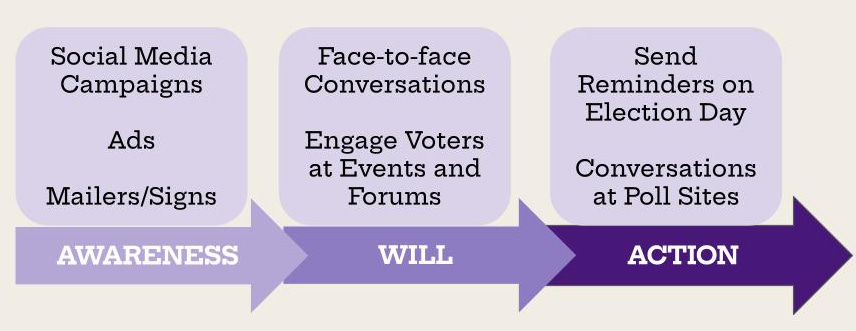
The campaign activities featured in the above graphic are illustrative - not an exhaustive list.
Rebalance the Budget
Across the five campaigns studied, between 70-82% of budgets went to paid media while grassroots outreach received as little as 1-6%, with meaningful voter engagement beginning only six to eight months before Election Day. This left campaigns structurally underprepared to address the persuasion challenge posed by ballot measures. In Colorado, 57% of voters finalized their decisions during the last week, indicating that recent opposition messaging addressed an informational gap that earlier engagement efforts could have potentially filled.
The case for rebalancing is one of the most replicated findings in political science. In a landmark series of field experiments, Gerber and Green (2000) randomly assigned registered voters to receive either a personal canvassing visit, a piece of direct mail, or a phone call before an election. Personal canvassing substantially increased turnout. Direct mail produced a modest effect, while phone calls had no effect. Subsequent experiments across six cities confirmed that face-to-face mobilization consistently outperformed other contact methods across a wide range of local election contexts (see Green, Gerber & Nickerson, 2003). In other words, the dollars campaigns spend on television ads and mailers are not equivalent to dollars spent on putting people in front of voters. The evidence suggests they are considerably less effective and yet the budget allocations of 2024 RCV campaigns reflect almost the opposite assumption. A conservative benchmark, supported by FairVote Action, the DC case, and this body of research, is dedicating at least 10% of campaign budgets to relational organizing. An additional recommendation is to start relational organizing 2-3 years in advance rather than treating it as a late-cycle supplement.
Start in the “Offseason”
DC organizers began community outreach in 2019, years before Initiative 83 was a formal campaign. Most of the other campaigns studied began meaningful voter engagement six to eight months before Election Day. That gap matters more than it might appear.
A landmark study by Broockman and Kalla (2016) tested whether door-to-door canvassing could produce lasting changes in voters’ attitudes beyond short-term bumps in turnout or stated support. They found that extended, empathetic face-to-face conversation produced a durable attitude change that held up months later, even in the face of counter-messaging. The underlying causal mechanism is the relationship between the messenger and the message recipient, not the message itself. A voter who has been personally persuaded by a trusted community member is a much harder target for late opposition messaging than one whose only exposure to the campaign was a yard sign or a TV ad. Campaigns that treat the pre-campaign period as downtime are forfeiting their highest-leverage organizing window and leaving themselves exposed to a late opposition surge that characterized several of the 2024 losses.
It is important to note as well that in a follow-up study, Kalla and Broockman (2018) find that canvassing effects are minimal in high-salience partisan races, where voters arrive with hardened priors. This null finding does not undermine the case for grassroots organizing for election reform. Rather, direct contact is most consequential precisely in the kinds of low-salience, low-information contests where election reform ballot measures compete for voter attention.
Structure National-Local Partnerships around Local Authority
A recurring organizational challenge across the five campaigns was the underutilization of local organizations’ community relationships and contextual knowledge. National partners brought valuable assets like polling data, broad campaign experience, and funding. However, relationships with in-state leads were too often strained by inconsistent communication and differing views on strategy, data interpretation, and budget allocation. Local actors frequently stressed that their knowledge of community context was sidelined during fast-moving campaign periods – when it was most needed.
This dynamic is not unique to election reform campaigns, but it is particularly costly in the ballot measure context. Unlike candidate races, where party affiliation provides voters with an easily accessible cognitive heuristic (i.e., shortcut), ballot measures on less-familiar topics require voters to trust a messenger. That trust is inherently local in nature. Future campaigns should establish clearer role definitions at the outset. This means local leads hold meaningful authority over community engagement strategy and budget allocation in their geographies, rather than serving as implementation arms for a nationally driven strategy.
Match Tactics to the Voter Journey
The awareness-will-action framework, noted above, maps campaign activities to where voters are in their decision-making process. Physical materials (i.e., yard signs) are effective at generating awareness but evidence suggests they rarely move voters from awareness to genuine understanding of an unfamiliar reform (Bowler & Donovan, 1998; Burnett, 2019). Paid digital advertising and social media campaigns can reach more voters with more content, but the evidence suggests they face similar limits when it comes to persuasion. Campaigns in RCV jurisdictions that invested heavily in direct voter contact (i.e., in person, by mail, and via email) consistently outperformed those that relied primarily on broadcast tactics. Dowling, Tolbert, Micatka, and Donovan (2024), analyzing administrative voter file data for over 2.5 million individuals, find that campaigns in RCV jurisdictions engage in significantly higher rates of in-person canvassing than campaigns in comparable plurality jurisdictions and that in-person contact produces the largest mobilization effects of any contact method studied.
Social media campaigns, digital ads, mailers, and yard signs are effective at generating awareness and making voters conscious that a ballot measure exists. They are considerably less effective at building the understanding and conviction needed to turn a “soft yes” into a vote. This distinction matters because ballot measure campaigns routinely treat awareness and persuasion as the same problem that can be addressed with the same tools.
Political scientists who study direct democracy have documented why this gap exists. Research on how voters make decisions on ballot measures consistently finds that voters navigating unfamiliar propositions rely heavily on mental shortcuts rather than policy analysis (Bowler & Donovan, 1998). When in doubt, voters default to “no” as a rational response to uncertainty. Critically, more recent research finds that increased campaign spending helps voters learn which organizations and figures have endorsed a measure, but does not reliably help them understand what the measure actually does (Burnett, 2019). Endorsement recognition shapes votes, whereas factual knowledge rarely does. This means the persuasion challenge for election reform campaigns is fundamentally relational – it requires trusted messengers delivering credible endorsements through direct contact, not just information campaigns delivering policy arguments through paid media. Face-to-face conversations at doors, events, forums, and polling sites are what the evidence shows convert persuadable voters into yes votes. Campaigns should sequence their tactics accordingly rather than treating all contact methods as interchangeable.
Prioritize Skeptical/Swing Communities
The DC campaign’s targeted investment in Wards 7 and 8, communities that had historically lower baseline support for election reform, drove support in those areas from roughly 55% in a May 2023 poll to 70–72% by Election Day. The trajectory reflects a deliberate choice to direct relational organizing toward communities where conversations could move the needle rather than concentrating ground game activity in areas of existing strength.
The broader mobilization literature supports the underlying logic. A review of 24 field experiments found that voters closest to the tipping point between participating and sitting out an election are more responsive to direct contact than either reliable voters or chronic non-participants, suggesting that the highest return on organizing investment lies in the persuadable middle, not the base (Enos, Fowler & Vavreck, 2014). Arceneaux and Nickerson (2009) reinforce this finding, concluding that campaigns are most effective when they target voters on the cusp rather than those already committed in either direction. In-person contact produces the largest mobilization effects of any contact method studied, and those effects are most consequential among voters who have not yet made up their minds (Dowling et al., 2024; Gerber & Green, 2000). Campaigns that concentrate their ground game in friendly territory are leaving their highest-return persuasion work undone.
Conclusion
Many campaigns are decided by forces beyond any campaign’s control, such as economic conditions, the national political environment, and the reach of well-funded opposition. However, ballot measure campaigns on ideas that voters are less familiar with occupy a different terrain. Where battle lines are less clearly drawn, and minds have not yet hardened, the difference between a narrow defeat and a transformational victory can come down to direct conversations with voters. The underperformance of some 2024 election reform campaigns was not due to a lack of financial resources. Rather, they lacked effective organization at critical junctures and locations, which can be improved for future efforts and movements.
Further Reading
Arceneaux, K., & Nickerson, D. W. (2009). Who is mobilized to vote? A re-analysis of 11 field experiments. American Journal of Political Science, 53(1), 1–16.
Bowler, S., & Donovan, T. (1998). Demanding Choices: Opinion, Voting, and Direct Democracy. University of Michigan Press.
Bowler, S., Donovan, T., & Happ, T. (1992). Ballot propositions and information costs: Direct democracy and the fatigued voter. Western Political Quarterly, 45, 559–568.
Broockman, D., & Kalla, J. (2016). Durably reducing transphobia: A field experiment on door-to-door canvassing. Science, 352(6282).
Burnett, C. M. (2019). Information and direct democracy: What voters learn about ballot measures and how it affects their votes. Electoral Studies, 57, 223–244.
Dowling, E., Tolbert, C., Micatka, N., & Donovan, T. (2024). Does ranked choice voting increase voter turnout and mobilization? Electoral Studies, 90, 102816.
Enos, R. D., Fowler, A., & Vavreck, L. (2014). Increasing inequality: The effect of GOTV mobilization on the composition of the electorate. Journal of Politics, 76(1), 273–288.
Gerber, A. S., & Green, D. P. (2000). The effects of canvassing, telephone calls, and direct mail on voter turnout: A field experiment. American Political Science Review, 94(3), 653–663.
Green, D. P., Gerber, A. S., & Nickerson, D. W. (2003). Getting out the vote in local elections: Results from six door-to-door canvassing experiments. Journal of Politics, 65(4), 1083–1096.
Green, D. P., & Gerber, A. S. (2019). Get Out the Vote: How to Increase Voter Turnout. Brookings Institution Press.
Kalla, J., & Broockman, D. (2018). The minimal persuasive effects of campaign contact in general elections. American Political Science Review, 112(1).