


The New Ideas Corner is an open invitation for readers, practitioners, scholars, organizers, and democracy-builders to share pro-democracy ideas, especially early-stage or underexplored ones. This is a place for constructive experimentation. These ideas aim to strengthen representation, participation, accountability, trust, or democratic governance more broadly. The views expressed here are the author’s own.
Joseph Crupi is a legal scholar whose work focuses on legislative process reform and proportional power-sharing. He makes the case that winner-take-all decision-making, not just winner-take-all elections, is a democracy problem worth taking seriously, and proposes a concrete way local governments could begin testing a more proportional alternative.
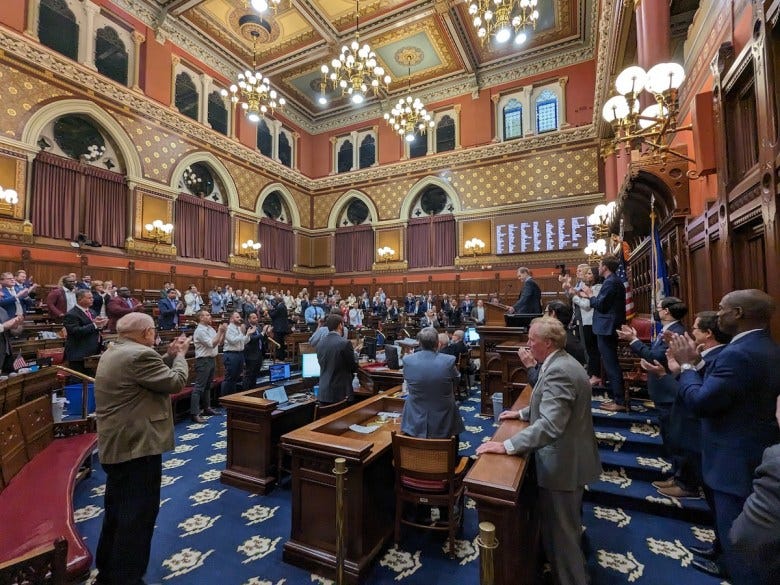
Image Credit: Hugh McQuaid / CTNewsJunkie
Legislatures make decisions through winner-take-all processes. Representatives in the majority can, and often do, pass legislation that ignores or even harms the interests of other groups. Despite the significance of this problem, exclusionary legislative processes have received little attention from democracy reform advocates. Inequities in electoral processes frequently make headlines, but the marginalization of elected representatives in legislatures is typically accepted as just the way things are.
Winner-take-all decision-making processes have a dramatic impact on the quality of democracy in the United States. Instead of serving the entire population, government decisions often serve only the interests of the majority party. In the U.S. Senate, both Democrats and Republicans have pushed through Supreme Court nominees despite opposition from the other party. In state legislatures, members in the majority often marginalize minority party members in important policy decisions. Here again, exclusionary practices are not limited to a single party. Democrats in Texas and Republicans in New York have both denounced governance in their states as exclusionary “one-party rule.”
Despite the pervasiveness of winner-take-all legislative processes, there is another way of thinking about how governments should make decisions. In the late 1900s, scholars such as Lani Guinier and Jane Mansbridge advanced a conceptual framework to challenge majoritarianism. They argued that people should have not only proportional representation of their interests, but also proportional power over outcomes. This vision of shared power was rooted in the democratic ideal of political equality. A legislature in which a majority can ignore the interests of a minority does not place all citizens on equal footing. If all people are to be politically equal, everyone’s interests must be given equal weight not just in elections but also in legislative decisions.
However, the movement for equality in legislatures never took off. The scholars who advocated for proportional legislative power never developed robust institutional design proposals or attempted to implement their ideas in government. Lani Guinier argued that legislative decision rules that allow a minority to win some of the time are more fair than rules that allow a majority to win all of the time, and she suggested that new legislative procedures such as a minority veto, rotating chairs on influential committees, and cumulative voting on legislation could increase the power of minority groups. But other scholars dismissed these ideas as unworkable. Over thirty years later, little has changed. Legislatures at all levels of government continue to use winner-take-all decision rules, and the prevailing view among scholars is that legislative majorities should rule.
While the idea never attracted widespread public attention during her lifetime, Guinier’s vision of proportional power remains a compelling picture of what democracy could be. The question today is whether that vision can become a reality. For democracy reform advocates who hope to implement a proportional power standard in legislatures, three challenges stand in the way.
The first is an institutional design challenge. How can we design a decision-making process that provides all representatives with proportional power over decisions while still ensuring that legislatures can make decisions efficiently? Proposals to decentralize agenda-setting power can allow legislative minorities to advance favorable legislation, but by themselves, these proposals are not sufficient to ensure that legislative minorities have the power to influence policy. Other common proposals such as a supermajority rule or a minority veto can give minority parties power in legislative decisions, but, as seen with the filibuster in the U.S. Senate, they may also allow a minority to block action completely, giving the minority party disproportionate power over legislative outcomes.
Designing a government where all representatives have proportional power over outcomes is possible, but it would require legislatures to adopt a very different type of decision-making process than a simple vote on legislation. I have proposed in an academic article and in an op-ed that legislatures could use arbitration to implement proportional power sharing. In this proposed process, arbitrators would review legislation to ensure that it adequately balances the interests of all representatives. Other possibilities could include relying on legislative agencies or an expanded parliamentarian’s office to uphold proportional power. While none of these approaches would be mathematically precise, they could still allow legislatures to make decisions that roughly reflect legislators’ proportional power to advance their interests.
The second challenge to implementing a proportional power standard is political viability. How can a decision-making method designed to increase minority power win support from a majority with the power to change the system?
Proportional power sharing would not always be politically viable in every legislature, but it may align with the incentives of both majority and minority parties in a surprising number of cases. In legislatures where partisan control changes frequently, adopting a proportional decision rule could allow both majority and minority parties to advance their interests more effectively over time. Particularly in bodies such as the U.S. Senate where procedural rules allow a minority to block legislation, proportional power could empower majorities to implement their agenda while still protecting minority interests. And in multi-party legislatures with no stable majority coalition, proportional power could provide a way to preserve legislative effectiveness and ensure that parties with few seats are not able leverage their position to exercise disproportionate power.
The third challenge to implementing a proportional power-sharing process is that it is unfamiliar and untested. How can busy legislators be expected to adopt a completely new decision-making system with no demonstrated evidence that it provides the benefits that it claims?
While it may not be realistic to implement new processes immediately in Congress or in state legislatures, many local government legislatures may be willing to test a simplified form of proportional decision making. Local government legislatures are often collegial, and many operate without the bitter partisan divisions that exist at the national and state levels. In places where local government representatives are accustomed to working together, proportional processes could highlight and formalize existing collaboration, providing an example for other legislatures to follow.
To start, local governments could test a modified version of a proportional process that would still allow a majority to control legislation. Here’s how this process might work. Before a final vote on a bill, the legislature could hold a majority-rule procedural vote on whether the bill gives proportional weight to each representatives’ interests. If a representative believes that their interests have not been given proportional weight, they could submit a statement to the legislature explaining their position. Representatives could also be given a few minutes of speaking time to debate the matter. The legislature would then vote on whether the bill gives all representatives’ interests proportional weight. If a majority votes yes, then the bill would advance to a final vote. If a majority does not vote yes, the bill would not advance, though it could be amended and resubmitted for consideration.
Implementing this simple procedural step in local governments would provide a valuable test for proportional processes, with few downsides for majority party representatives. A majority-rule procedural vote would not change the balance of power in a legislature or limit a majority’s ability to pass legislation, and it would not place a significant burden on representatives’ time. It would, however, provide useful information about the design of a proportional interest-balancing process. Procedural debate would demonstrate how representatives understand and apply a proportional power standard, and it could reveal points of disagreement or confusion where a proportional power standard would need to be clarified or refined. Testing a proportional power standard through a procedural step in local governments could also increase familiarity with proportional processes and ultimately allow representatives in other legislatures to make an informed decision about whether to adopt a similar standard.
While proportional power offers an ambitious vision of what democracy could be, the first steps toward achieving this vision are strikingly modest. If just a few local governments decide to test limited forms of proportional interest balancing, the increased public visibility and lessons learned from these tests could catalyze a movement for legislative processes that truly include everyone. Given its significant potential impact and viability across several political contexts, legislative process reform offers a promising next frontier for democracy reform advocates.